Components of the Service Level Agreement
Customer choose a plan for each Phonemos subscription: Team, Business or Enterprise. Based on this choice, a different service level agreement (SLA) applies.
The SLA comprises three components: SLA Goals, Backup Plan and Business Continuity Plan.
The SLA Goals component regulates the availability and responsiveness of IT services and support.
The Backup Plan regulates the creation of backups of the system and data and their retention.
The Business Continuity Plan defines the targets regarding the handling of extensive system failures.
Definitions
The operating time is the period of time during which the productive systems are available to the customer.
The standby time is the period of time during which provider staff can ensure support of the service and receive and process messages. The time measurement for the response and resolution time is interrupted for the time outside the standby time.
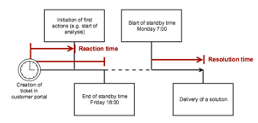
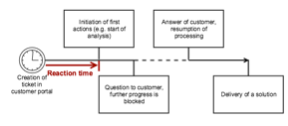
The time to first response is understood to be the period of time within the standby time from the time the message is received in the linkyard customer portal (https://servicedesk.linkyard.ch/) until it is put to work by an employee of the Provider.
Downtime defines a period during operating time within which the service was entirely unavailable to the users.
The system availability is evaluated on an annual basis and is calculated from the operating time minus the system downtime in relation to the operating time, whereby announced interruptions during the agreed maintenance windows are not counted as system downtime.
A maintenance window is the period of time during which the provider is allowed to carry out planned maintenance work on the system.
Error classes
Software errors and operational faults are divided into the following error classes:
Class | Definition | Criteria |
|---|---|---|
Blocker | Prevents operation The error does not permit use in the sense of the essential purpose of use. |
Complete interruption of operation. Central functions of the system cannot be used. All users of the client are affected. No workarounds are available. Example: Login is not possible. |
Critical | Partially prevents operation Use in the sense of the essential purpose of use is ensured. However, there is a significant error in an important sub-function or the work is only ensured with the use of elaborate workarounds. |
Partial interruption of operation. Central functions of the system cannot be used. A majority of the client's users are affected. The client can use an organisational or technical workaround for a limited time. Example: An interface to an important third-party system (e.g. SAP) does not work. |
Average | Obstructing operations The use of the software in the sense of the essential purpose of use is guaranteed. However, there are errors in partial functions which make the work more difficult. |
No interruption of operation. Central functions of the system can be used. Obstruction of a few users of the client. Workarounds are not necessary or very simple. Example: Master data cannot be adjusted via the GUI. |
Minor | Disrupting operations Errors that affect the use of the solution only insignificantly. |
No interruption of operation. Minor impairment due to avoidable additional work, lack of comfort. Bypass solutions are not necessary. Example: spelling mistakes, errors in the documentation. |
The defect classes Blocker and Critical are considered significant defects, the defect classes Average and Minor are considered insignificant defects.
SLA Goals
SLA Goals: | Basic (Plan Team) | Extended (Plan Business) | Premium (Plan Enterprise) |
|---|---|---|---|
Service times, system availability | |||
Operating time production | 7x24 | 7x24 | 7x24 |
Operating time test system | on demand | on demand | on demand |
System availability | >99.6% | >99.9% | >99.9% |
Standby time | Office hours1 | Office hours1 | 7x24, 365 Days/year |
Response time during office hours | |||
| Best Effort | 4 Hrs. | 1 Hrs. |
| |||
| next | 4 Hrs. | |
| next | ||
| |||
Response time outside office hours | |||
| Best Effort | next | 2 Std. |
| 4 Std. | ||
| next | ||
| |||
| |||
1Monday to Friday 07:00-18:00, excluding federal and cantonal holidays of the Canton of Bern
Maintenance windows
The provider may apply changes to the test and production systems without prior notice at any time. Any downtime caused by such changes is taken into account for the calculation of system availability.
Major planned maintenance work (e.g. elaborate software updates, migrations, etc.) takes place at a time explicitly agreed with the customer in advance. The corresponding system downtime is not taken into account in the calculation of system availability.
Backup plan
Backup Plan: | Week (default for all plans) | Month (Option) | Year (Option) |
|---|---|---|---|
Backup retention period | Last 7 days readings | corresponds to Week plus: last 4 weeks readings | corresponds to Month plus last 12 month readings |
Recovery Point Objective (RPO) | 24 Hrs. | 24 Hrs. | 24 Hrs. |
Recovery Time Objective (RTO)[1] | Reaction time (cf. section 2) plus 4 hrs. | Reaction time (cf. section 2) plus 4 hrs. | Reaction time (cf. section 2) plus 4 hrs. |
1 With cluster/data centre location still functioning, up to 100 GB of data
Business continuity plans
Business Continuity Plan: | Basic (plan Team) | Extended (plan Business/Enterprise) |
|---|---|---|
System Site Redundancy | No, one location (cluster/data centre) | Yes, an additional disaster recovery site at a second infrastructure provider is available at all times, which could be put into operation in the event of a complete failure of the main site. |
Server | Yes, the system is operated on a cluster with several nodes. In the event of a failure, an automatic failover takes place. | |
Backup Site Redundancy | Yes, backups are additionally stored geo-redundantly and encrypted at a second location. | |